
Pacific Diplomats Clash Over Joint Response to China’s Nuclear-Capable Missile Test
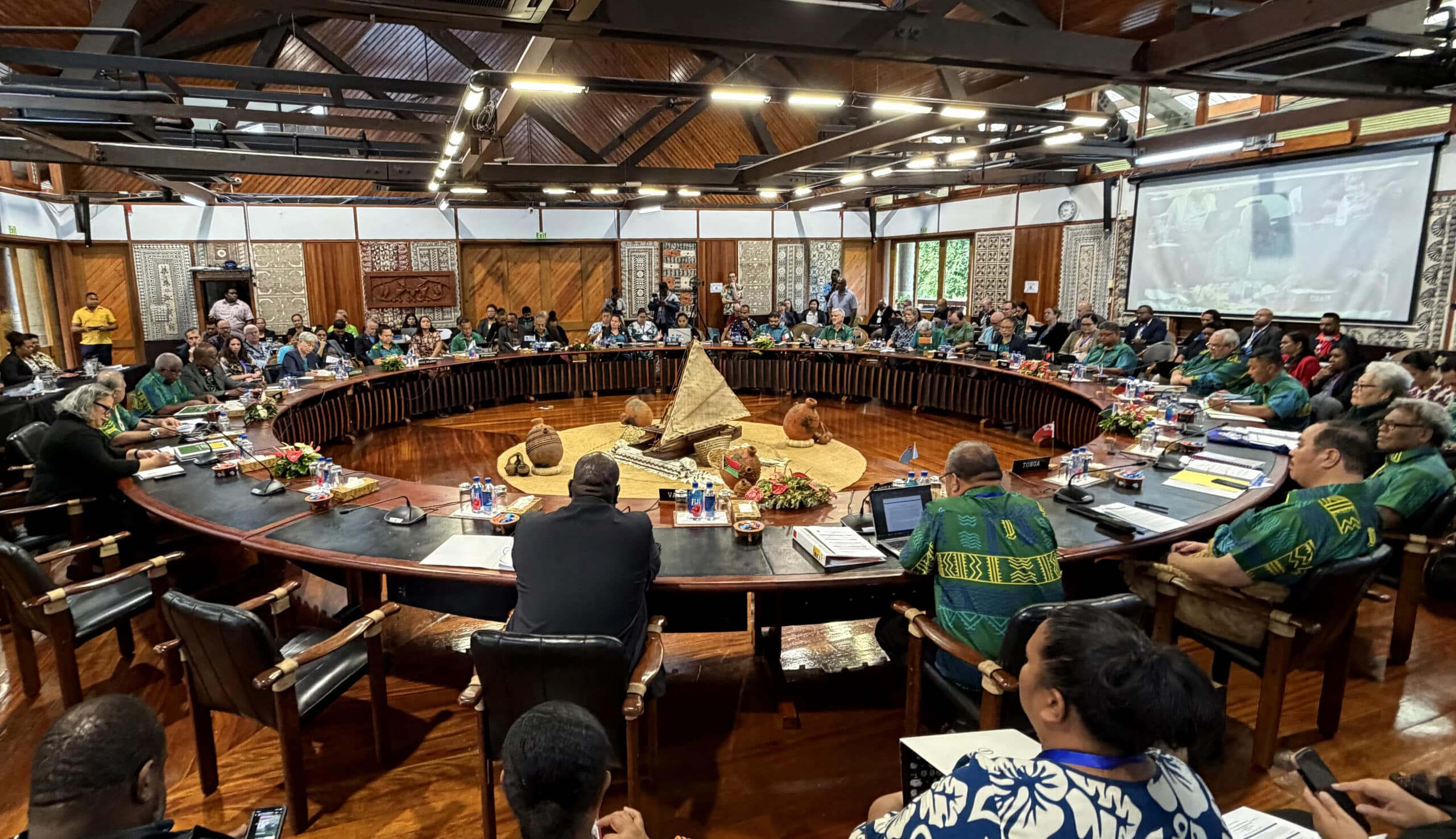
SUVA, Fiji — Pacific diplomats gathered in Fiji for their annual meeting faced a contentious debate Friday over issuing a joint statement condemning China’s recent test of a nuclear-capable intercontinental ballistic missile. The launch, which Beijing announced with minimal prior notice to regional nations, has heightened tensions in a Pacific region where China has been expanding its influence.
The missile reportedly landed in the ocean near the Solomon Islands, Nauru, and Tuvalu, according to monitoring groups. The test sparked condemnation from several Pacific leaders, yet the 18-member Pacific Islands Forum has not released a formal response. New Zealand’s Foreign Minister Winston Peters, known for his outspoken stance, advocated for a unified statement denouncing the launch. He told reporters that the discussions would be open but cautioned that some members might hold predetermined positions.
Tuvalu, a diplomatic ally of Taiwan, also called for a joint statement and expressed frustration at not receiving advance notice of the missile test. Pasuna Tuaga, Tuvalu’s Permanent Secretary of Foreign Affairs, Labour and Trade, emphasized the country’s refusal to be intimidated by external powers. He said Tuvalu sought a strong collective statement from the Pacific to reinforce their position and noted that the missile landed very close to Tuvalu’s territory. Tuvalu has requested assistance from multiple countries, including the United States and China, to locate the missile’s dummy warhead.
Australia’s Foreign Minister Penny Wong expressed hope before the meeting that China would recognize the clear concerns already voiced by Pacific nations regarding the missile test. She confirmed that the majority of the Pacific Islands Forum members had expressed unease about China’s ballistic missile activity.
However, resistance emerged from China-friendly Pacific nations such as Kiribati, Nauru, and Vanuatu, which reportedly showed little interest in formally criticizing one of their major partners. This division suggests that any formal response from the meeting in Suva might be diluted, potentially emphasizing regional security without explicitly mentioning China or the missile test.
The diplomats’ meeting precedes a full leaders’ summit scheduled for September in Palau, an archipelago west of the Philippines that maintains diplomatic relations with Taiwan, a self-ruled democracy claimed by Beijing. Discussions during the Fiji meeting also included which key partners should be invited to the upcoming leaders’ summit. This issue remains sensitive, as last year the Solomon Islands barred all partner nations from attending their leaders’ meeting after China demanded Taiwan’s exclusion.
Winston Peters warned of the persistent risk of external interference in Pacific affairs, cautioning against outsiders influencing the region’s collective decisions. The ongoing debate reflects the complex geopolitical dynamics in the Pacific, where regional nations balance relations with major powers amid concerns over security and sovereignty. The outcome of the Fiji meeting and the upcoming leaders’ summit in Palau will be closely watched for indications of the Pacific Islands Forum’s stance on China’s military activities and broader regional security challenges.
AI-assisted original article by 1news, based on reporting from INQUIRER.net. Featured image credited to the source.