
Spain Deploys Military as Thousands of Migrants Surge into Ceuta from Morocco
AI-assisted original article by 1news, based on reporting from GMA News Online. Featured image credited to the source.
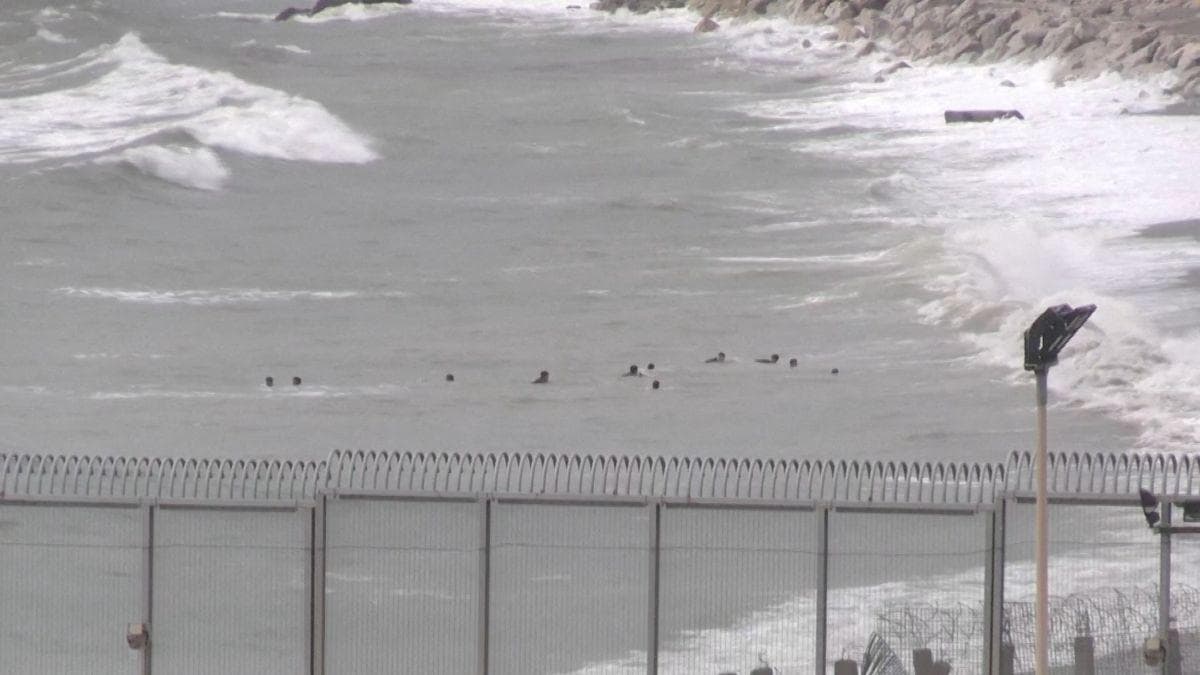
Spain deployed military units on Thursday to reinforce police forces in the Spanish enclave of Ceuta, located in North Africa, as thousands of migrants crossed into the territory by sea and land from neighboring Morocco. Authorities also moved to restrict access to Melilla, another Spanish enclave nearby, amid escalating border tensions.
State television TVE reported that between 2,000 and 3,000 migrants entered Ceuta on Thursday, though Reuters could not immediately verify these figures. Video footage captured hundreds of migrants swimming or floating on inner tubes from the Moroccan side, while others broke through a gate on land and ran into the city.
In the Moroccan town of Fnideq, just beyond Ceuta’s border, witnesses told Reuters that Moroccan authorities used water cannons late Thursday to deter migrants from crossing. Despite these efforts, many migrants persisted. One migrant, Jadid Zacaria, who had just arrived in Ceuta with wet hair and clothing, described the crossing as difficult but said their determination helped them succeed. Some migrants shouted slogans in support of Spain as they entered the territory.
Meanwhile, in Melilla, Spain’s second autonomous city in northern Africa, local media and human rights organizations reported clashes at the Beni Ansar border point late Thursday. This crossing has been the only open border between Morocco and Melilla for the past six years. Omar Naji of the Moroccan Association for Human Rights reported that at least three vehicles were set on fire and injuries occurred among migrants and security forces during the unrest. Moroccan authorities did not respond to requests for comment.
Local officials in Ceuta found nine bodies on Thursday, adding to a recent total of 60 migrants who have died attempting to cross into the enclave in recent months. To bolster security, the Spanish government sent 200 specialized police officers and 60 troops from the mainland to reinforce Ceuta’s regular forces. It remains unclear whether similar reinforcements were dispatched to Melilla, as authorities did not immediately comment.
Reuters reporters observed groups of young people walking north along a highway about 150 kilometers south of Ceuta in Morocco, hoping to reach Spanish territory. The current situation evokes memories of 2021, when approximately 10,000 migrants from Morocco and sub-Saharan Africa, many of them minors, entered Ceuta, a city with a population of around 85,000.
Spain’s Prime Minister Pedro Sanchez and Interior Minister Fernando Grande-Marlaska are scheduled to visit Ceuta on Friday to meet with security forces and local officials. Meanwhile, many shops in Ceuta remained closed on Thursday. Enrique Serrano, a local clothing store owner, said business owners were organizing self-defense measures due to concerns that police resources might be insufficient. He explained that the situation was extremely tense and that hundreds of migrants had rushed through the border fence within minutes early Thursday.
Ceuta and Melilla represent the European Union’s only land borders with Africa and periodically experience surges in attempted migrant crossings as people seek entry into Europe. Spain’s Socialist government has distinguished itself in Europe for its pro-migrant policies, recently launching a program to grant legal status to approximately 500,000 undocumented migrants. This initiative has triggered an influx of applications that is double that number.
Right-wing parties have criticized the government’s migration policies, arguing that they encourage more migrants to come to Spain. The conservative opposition leader, Alberto Núñez Feijóo, described the situation in Ceuta as desperate and called on the government to address what he termed a national security crisis. Earlier on Thursday, Ceuta’s mayor, Juan Jesús Vivas, urged the national government to declare an emergency over the mass arrivals.
Italian Foreign Minister Antonio Tajani also criticized Spain’s migration policy, describing it as misguided in light of the images coming from Ceuta.
Earlier this month, Spain’s Supreme Court ruled that migrants intercepted at sea while attempting to reach Ceuta or Melilla cannot be immediately returned under the enclaves’ special “border rejection” regime, which allows authorities to send back people caught crossing the border fences without due process. The Spanish government attributed the recent surge in migrant crossings to criminal organizations exploiting this ruling, rather than to the legal status program for undocumented migrants.
A Guardia Civil spokesperson told Reuters that the influx had been a slow trickle since the Supreme Court’s decision but exploded on Thursday. The Interior Ministry said it was working closely with Moroccan authorities to manage the surge, having prevented thousands of migrants from illegally entering Ceuta in recent days.
Mauricio Valiente, director of the Spanish Commission for Refugees, which has legal representatives working in Ceuta, said the migrants crossing into the enclave were primarily of Moroccan and sub-Saharan origin, including families.