
Two firefighting helicopters collide amid Greece’s battle against wildfires; Hungary shuts nuclear plant due to drought
AI-assisted original article by 1news, based on reporting from GMA News Online. Featured image credited to the source.
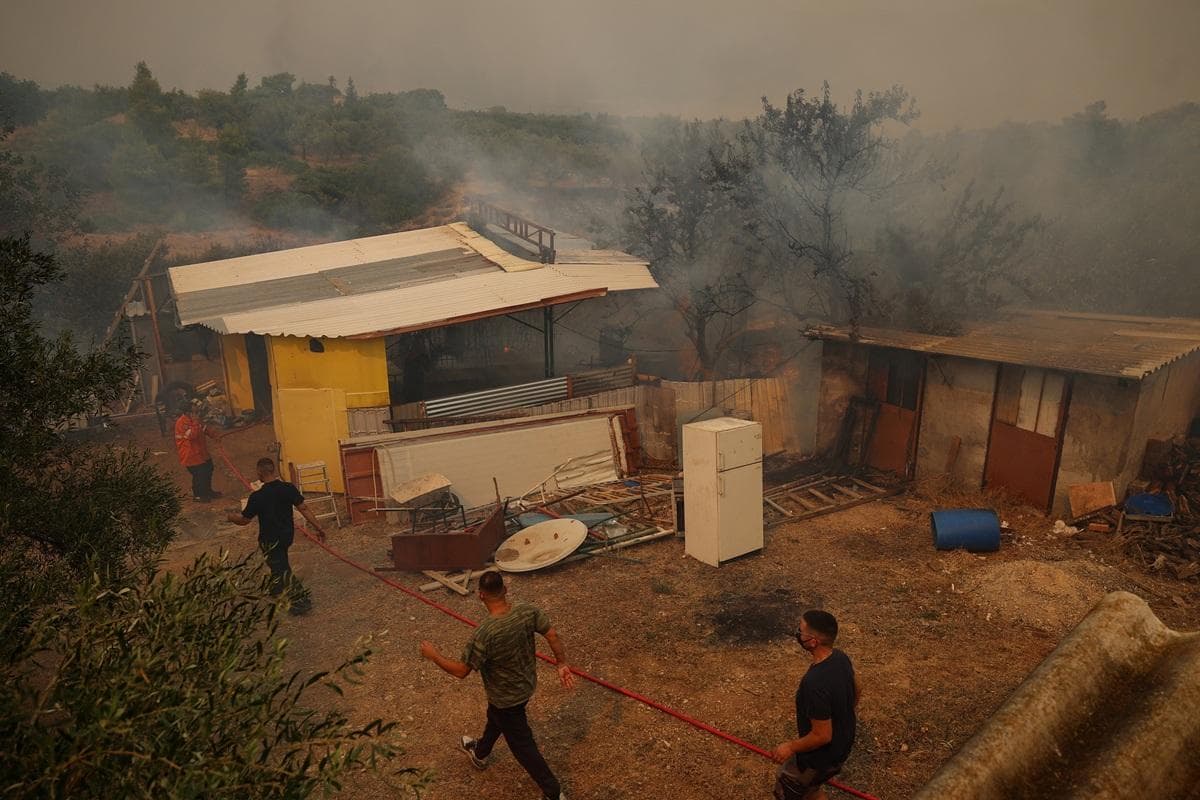
Two firefighting helicopters collided in Greece on Sunday while assisting efforts to control a massive wildfire northwest of Athens that has destroyed over 100 homes. The incident occurred in the Attica region near Psatha, as crews battled flames fueled by recent gale-force winds.
The Greek fire service confirmed the collision and stated that the crew of one helicopter had been located and were safe, with ambulances dispatched to retrieve them. The second helicopter’s crew was also located, prompting an ongoing search-and-rescue operation. Video footage circulating on social media showed two helicopters approaching each other at low altitude before the rotor of the lower aircraft struck the underside of the upper one, causing a fiery crash. The second helicopter released its water load and departed the scene. Reuters has not independently verified the footage’s authenticity.
The wildfire, which has devastated more than 10,000 hectares of land, initially ignited near Porto Germeno on the Gulf of Corinth, approximately 60 kilometers northwest of Athens. Although the strong winds that had driven the fire subsided, the flames crossed a mountain to the south, reaching the settlement of Veniza and a nearby military firing range, where unexploded ordnance was ignited. Firefighters concentrated on preventing the fire’s advance toward the coastal town of Megara, home to around 30,000 residents.
Greek authorities issued emergency evacuation alerts for several settlements in western Attica, including an industrial estate near Megara. Residents of the village of Agios Konstantinos were actively attempting to contain the blaze themselves. Tasos Tzempelikos, a 61-year-old local, described how he and his son were using water to fight the fire, acknowledging that firefighting forces could not be everywhere at once.
Prime Minister Kyriakos Mitsotakis acknowledged the severity of the situation in his regular Sunday message, noting that the intensity of the weather and natural forces had overwhelmed human planning and operational capabilities. Nearly 500 Greek firefighters, supported by vehicles, heavy machinery, and firefighting aircraft, including reinforcements from France and Romania, were deployed to combat the blazes.
Meanwhile, a fresh wildfire on the Ionian island of Kefalonia prompted evacuations of several settlements in the Pastra area in the island’s south. Across Europe, wildfires have been widespread this summer following record-breaking heatwaves and prolonged dry spells, conditions experts attribute to climate change.
In France, wildfires in the Gironde and Var departments showed signs of easing over the weekend. Authorities reported only minor flare-ups in southwestern Gironde and no overnight spread in the Var region. Residents like Georges Blanc in Monfort-Sur-Argents, Var, who had fled the fire, returned to their homes to extinguish hot embers and prevent flare-ups, supported by firefighting aircraft and crews.
In central Spain, wildfires that had consumed tens of thousands of hectares were mostly under control, though firefighters continued to manage reignitions. A forest fire in the western province of Caceres led to the evacuation of approximately 800 people on Saturday; these residents were allowed to return on Sunday but remained confined to their homes as the fire remained active.
Beyond wildfires, Europe is grappling with drought and historically low water levels in major rivers such as the Rhine and the Danube. The Danube has recorded its lowest levels ever in Hungary, Serbia, and Romania, severely impacting hydropower production and navigation. In Hungary, Prime Minister Péter Magyar warned of a critical five-day period as the drying Danube forced the country’s sole nuclear power plant to shut down for the first time in over 40 years. The plant’s closure, due to insufficient water for cooling, threatens energy supplies amid an impending heatwave.
The drought has also disrupted shipping and tourism in Hungary and led to water-use restrictions in more than 100 cities and villages. Serbia’s energy minister reported that the country’s largest hydropower plant was operating at only 20% capacity due to the low Danube levels.
The combination of extreme heat, drought, and wildfires across Europe underscores the growing challenges posed by climate change, with emergency services and governments struggling to respond to multiple simultaneous crises. Efforts continue to contain the fires in Greece and elsewhere, while authorities monitor water levels and energy supplies closely amid the ongoing heatwave.